BLATN Handheld Particle TVOC Monitor vs BLATN Handheld Multi-Gas Particle Monitor: Spec Comparison
As an Amazon Associate we earn from qualifying purchases. Links on this page are affiliate links.
This comparison looks at the blatn handheld particle tvoc monitor vs handheld multi gas particle options from BLATN. Both devices monitor indoor air quality using laser, electrochemical, and semiconductor sensors. They share a 2200 mAh battery, data logging, and an air quality alarm. The main difference lies in their additional sensor capabilities. One model focuses on particle counts and chemical pollutants, while the other adds carbon dioxide detection using NDIR technology. You need to decide which pollutant profile matches your home environment.
Key differences
| Aspect | BLATN Handheld Particle and TVOC Monitor | BLATN Handheld Multi-Gas and Particle Monitor |
|---|---|---|
| Target Pollutants | PM2.5, PM1.0, PM10, TVOC, HCHO | PM2.5, PM1.0, PM10, TVOC, HCHO, CO2 |
| Sensor Technology | Laser, electrochemical, semiconductor | Laser, NDIR, electrochemical |
| CO2 Detection | Not listed | NDIR Non-Spectral Infrared CO2 Sensor |
| Color | Orange/black | Green black |
| Dimensions | 4.33 x 3.8 x 2.24 inches | 5.5 x 1.57 x 2.55 inches |
Which one should you choose?
Choose BLATN Handheld Particle and TVOC Monitor if
- You need to monitor fine particulate matter and volatile organic compounds without carbon dioxide data.
- You prefer a wider, more compact device that fits easily in a palm.
- You want an orange and black color scheme for the unit.
Choose BLATN Handheld Multi-Gas and Particle Monitor if
- You require carbon dioxide monitoring alongside dust and chemical pollutants.
- You want an NDIR sensor for more stable CO2 readings over time.
- You prefer a taller, narrower device design.
Verdict: Choose the BLATN Handheld Particle and TVOC Monitor if you only need to track dust and chemical gases. Select the BLATN Handheld Multi-Gas and Particle Monitor if carbon dioxide levels are a priority for your indoor air quality assessment. Both units offer identical battery life and data logging capabilities.
BLATN Monitors: Key Differences
Pollutant Detection
Product A, the BLATN Handheld Particle and TVOC Monitor, measures dust, PM2.5, TVOC, PM10, and formaldehyde. It uses a semiconductor sensor for TVOCs and an electrochemical sensor for formaldehyde. Product B, the BLATN Handheld Multi-Gas and Particle Monitor, includes all those pollutants plus carbon dioxide. It adds an NDIR sensor for CO2 detection. This makes Product B more versatile for monitoring overall indoor air quality, including ventilation levels via CO2. Product A focuses strictly on particulates and chemical pollutants without gas measurement.
Sensor Technology
Both devices use laser, electrochemical, and semiconductor sensors for particle and chemical detection. Product A relies on semiconductor technology for TVOCs. Product B uses the same semiconductor approach for TVOCs but adds NDIR technology for carbon dioxide. NDIR sensors are generally more stable and specific for CO2 than other methods. This gives Product B a technical advantage in gas sensing accuracy. Product A lacks this specific gas sensor type, limiting its chemical analysis scope to volatile organic compounds and formaldehyde only.
Physical Dimensions
Product A measures 4.33 inches in length, 3.8 inches in width, and 2.24 inches in height. It weighs 7.68 ounces. Product B is 2.55 inches long, 1.57 inches wide, and 5.5 inches high. It also weighs 7.68 ounces. Product A is wider and shorter, making it more compact in horizontal footprint. Product B is taller and narrower, resembling a slim wand. The choice depends on whether you prefer a wider handheld grip or a slimmer profile for pocket storage. Both fit in one hand.
Data Logging
Both monitors support data storage and export with date and time stamps. They log data once every minute and can store up to 400 days of records on an 8G card. Product B logs twelve testing items, including the added CO2 readings. Product A logs the items it measures, which are fewer than twelve. Both offer identical storage capacity and logging frequency. The difference lies in the volume of data points recorded per session. Product B provides a more comprehensive historical record due to the extra sensor.
Battery Power
Both devices use a 2200 mAh rechargeable lithium battery. They share the same power source capacity. Neither product lists a different battery size or type in the specifications. Both include an air quality alarm system. The runtime will likely be similar for both units under identical usage conditions. There is no difference in power specifications. You can expect comparable battery performance from either model, as the hardware power requirements are nearly identical for the sensors used.
Which BLATN monitor fits your needs
Users needing carbon dioxide tracking
Product B includes an NDIR CO2 sensor, which Product A lacks. This allows you to monitor carbon dioxide levels alongside PM2.5, TVOC, and formaldehyde. The device logs all twelve testing items every minute. If tracking ventilation and CO2 buildup is important for your indoor air quality assessment, this multi-gas capability is the deciding factor for your purchase.
Those preferring compact handheld size
Product B is significantly narrower at 1.57 inches compared to Product A's 3.8 inches. Both weigh 7.68 ounces, but Product B’s slim profile makes it easier to hold or pocket. It retains the same 2200 mAh battery and data logging features. If you prioritize a smaller footprint for handheld portability without sacrificing sensor coverage, this form factor suits you better.
Buyers wanting standard dust and gas focus
Product A covers the essential indoor pollutants: PM2.5, TVOC, formaldehyde, and particulate matter. It uses a semiconductor sensor for TVOCs and an electrochemical sensor for formaldehyde. It lacks CO2 detection, which simplifies the reading interface if you do not need that specific metric. For users focused on dust, VOCs, and formaldehyde, this model provides the necessary data without the extra CO2 feature.
The products compared
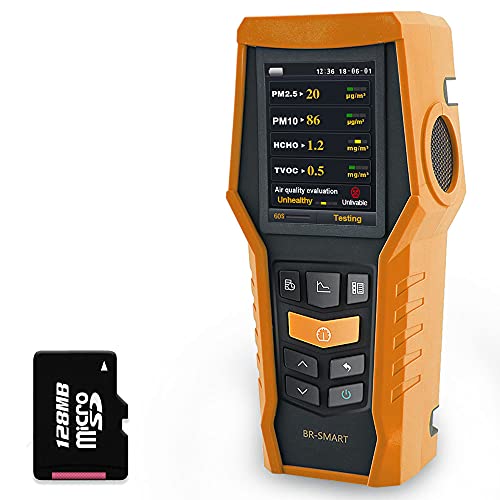
BLATN Handheld Particle and TVOC Monitor
Best for: detailed indoor air quality tracking
- Target Pollutants
- TVOC, PM2.5, HCHO, PM1.0, PM10
- Sensor Technology
- Laser, electrochemical, semiconductor
- Power Source
- 2200 mAh rechargeable lithium battery
- Alert System
- Air quality alarm
- Features
- Air Quality Monitor
- Dimensions
- 4.33 × 3.8 × 2.24 inches
View on Amazon: BLATN Handheld Particle and TVOC Monitor Affiliate link
The BLATN Smart 126s is a handheld air quality monitor that measures PM1.0, PM2.5, PM10, TVOC, and formaldehyde. It uses laser, electrochemical, and semiconductor sensors for real-time data. The device includes a 2200 mAh battery and logs data for up to 400 days. You get a compact unit that fits in your hand. It suits those who want detailed indoor air analysis without a stationary setup.
Pros
- Measures six particle sizes including PM0.3 to PM10
- Electrochemical formaldehyde sensor with auto calibration
- Logs data for up to 400 days
- 2200 mAh rechargeable battery
Cons
- No app connectivity for remote viewing
- No Bluetooth for wireless data transfer
- No Wi-Fi for cloud storage
Good fit if
- You need to track formaldehyde levels
- You want detailed particle size breakdowns
- You prefer local data logging
Skip if
- You require real-time app monitoring
- You need wireless data export
- You want a larger display screen
Verdict: BLATN Smart 126s Air Quality Monitor is ideal for users who need precise formaldehyde and particle data without relying on smartphone apps.

BLATN Handheld Multi-Gas and Particle Monitor
Best for: Detailed indoor air quality analysis with data logging
- Target Pollutants
- CO2, PM2.5, TVOC, HCHO, PM1.0, PM10
- Sensor Technology
- Laser, NDIR, electrochemical
- Power Source
- 2200 mAh rechargeable lithium battery
- Alert System
- Air quality alarm
- Features
- Air Quality Monitor
- Dimensions
- 2.55 × 1.57 × 5.5 inches
View on Amazon: BLATN Handheld Multi-Gas and Particle Monitor Affiliate link
This handheld monitor tracks CO2, PM2.5, TVOC, and formaldehyde using laser, NDIR, and electrochemical sensors. It logs data for up to 400 days and alarms based on US standards. The 2200 mAh battery supports portable use. It suits users needing detailed indoor air analysis for dust, gases, and chemicals.
Pros
- Measures PM0.3 through PM10 and PM1.0/2.5/10 concentrations
- NDIR CO2 and electrochemical HCHO sensors included
- Logs 12 data items for up to 400 days
- 2200 mAh rechargeable battery with silent fan
Cons
- No mobile app or Bluetooth connectivity for remote viewing
- No remote control for operation
- Limited to indoor air quality monitoring only
Good fit if
- You need to track formaldehyde and CO2 levels alongside dust
- You want to store historical air quality data locally
- You prefer a standalone device without app dependencies
Skip if
- You require real-time data streaming to a smartphone
- You need outdoor weather monitoring capabilities
- You prefer a larger display for easy reading
Verdict: BLATN BR-SMART Indoor Air Quality Monitor offers comprehensive indoor pollutant tracking with extensive data logging. It fits users who need detailed, offline analysis of dust, gases, and chemicals in their home or office.
Specifications side by side
| Spec | BLATN Handheld Particle and TVOC Monitor | BLATN Handheld Multi-Gas and Particle Monitor |
|---|---|---|
| Target Pollutants | TVOC, PM2.5, HCHO, PM1.0, PM10 | CO2, PM2.5, TVOC, HCHO, PM1.0, PM10 |
| Sensor Technology | Laser, electrochemical, semiconductor | Laser, NDIR, electrochemical |
| Power Source | 2200 mAh rechargeable lithium battery | 2200 mAh rechargeable lithium battery |
| Alert System | Air quality alarm | Air quality alarm |
| Target Pollutant | Dust, PM2.5, TVOC, PM10, Formaldehyde | Dust, CO2, PM2.5, TVOC, PM10, Formaldehyde |
| Features | Air Quality Monitor | Air Quality Monitor |
| Dimensions | 4.33 × 3.8 × 2.24 inches | 2.55 × 1.57 × 5.5 inches |
| Weight | 7.68 ounces | 7.68 ounces |
| Color | Orange/black | green black |
| Model | BR-smart | BR-SMART |
Frequently asked questions
Which BLATN monitor is better for tracking carbon dioxide levels?
The BLATN Handheld Multi-Gas and Particle Monitor is the better choice. It includes an NDIR sensor for carbon dioxide detection, which the Particle and TVOC Monitor lacks. This allows you to track CO2 alongside PM2.5, TVOC, and formaldehyde for a complete indoor air analysis.
Do both devices measure formaldehyde and TVOC?
Yes, both monitors measure formaldehyde and Total Volatile Organic Compounds. The Particle and TVOC Monitor uses a semiconductor sensor for TVOCs and an electrochemical sensor for formaldehyde. The Multi-Gas Model includes these same sensors, ensuring you get precise data on chemical pollutants in both units.
How do the physical dimensions of the two monitors compare?
The models differ in shape and size. The Particle and TVOC Monitor is wider at 3.8 inches but shorter in height. The Multi-Gas Monitor is narrower at 1.57 inches but taller at 5.5 inches. Both share the same weight of 7.68 ounces, making them portable.
Can I use these monitors without a smartphone app?
Yes, you can use them independently. The Particle and TVOC Monitor is ideal for users who need precise data without relying on apps. Both devices feature data logging capabilities, allowing you to analyze offline records of dust, gases, and chemicals directly from the hardware.
What pollutants does the Multi-Gas Monitor detect that the other does not?
The Multi-Gas Monitor detects carbon dioxide in addition to the standard pollutants. It measures dust, PM2.5, TVOC, PM10, and formaldehyde, just like the Particle and TVOC Monitor. The addition of CO2 tracking makes it suitable for comprehensive indoor air quality analysis in homes or offices.
What color options are available for each model?
The Particle and TVOC Monitor comes in an orange and black color scheme. The Multi-Gas Monitor is available in green and black. These color distinctions help you identify the specific model quickly, especially if you own both devices for different rooms or monitoring tasks.